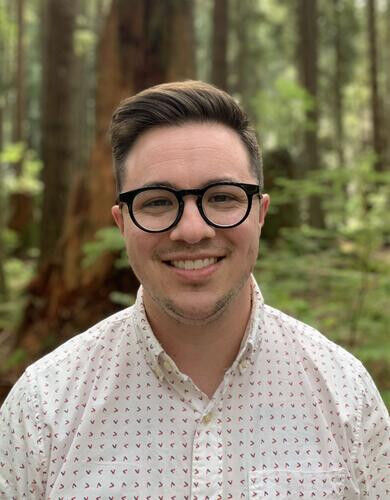
Jamie Anderson says he hopes his dissertation can encourage greater understanding and dialogue
A Werklund School of Education PhD candidate is researching how transgender teachers are represented in media and policy discourse over time by exploring how news media, press releases and research represent transgender teachers and related policy debates.
Jamie Anderson, who is transgender, is examining media such as TV news clips, newspaper articles, press releases and research within Canada and the U.S. Anderson, MA’20, is doing this work for his PhD dissertation which he hopes to have completed later this year. Anderson says his aim is to understand how transgender policies, as reported in media, have informed common language usage and how that language has impacted public understanding of transgender teachers and their professional contexts.
Anderson does this research using a method called critical discourse analysis, which examines how language shapes social realities and public understanding. He says an example of this influence would be disproportionate media attention to what he refers to as "anti-trans issues," resulting in an inflated public perception of how prevalent these issues are in society. Anderson says this distinction is important, because the public and media discourse do not privilege trans issues as defined by the trans community, but rather the issue of trans existence as defined by debates about whether trans inclusion is justifiable.
"Due, in part, to the outsized amount of attention given to anti-trans issues, public polling indicates that people dramatically overestimate the size of our community and particularly the number of trans youth," says Anderson. "But the reality is so different. We are talking about less than one per cent. When there is significant legislative and policymaking efforts directed toward trans people, it can reinforce this idea that the size of the trans community is ballooning and that is a threat."
The research
Anderson is reviewing media and policy dating back several decades, with the bulk of resources beginning in the 1980s when reporting on transgender teachers began appearing more frequently. He says the tone of media around trans teachers has shifted since then.
"In the ’80s, when it was ’revealed’ that there was a trans teacher that was transitioning at a school, there was a type of media lens of discovery and almost tabloid-like treatment of that experience. It was treated as spectacle and deceit," says Anderson. "Over time, that framing has shifted. More recent coverage may focus on transgender teachers receiving professional recognition or creating new programs, where their gender identity is not the central focus of the story."
Anderson also added that, where before negative perceptions of transgender teachers tended to focus on individual trans people, which often affected the individual very personally - to the point where they could be fired or forced to move - now, negative accounts are not as individual focused, but more broad, referring to anti-trans policies or sentiment directed toward all trans people.
Anderson is also researching how employment protections for transgender teachers intersect with emerging education policies and hopes his findings will be able to explore the relationship between trans teachers as what he calls "thorny bodies" within policy debates surrounding gender diversity in schools.
Dr. Tonya Callaghan , BA’90, BEd’96, PhD, is Anderson’s doctoral supervisor and academic director for LGBTQ2S+ Equity, Inclusion and Intersectionality in the Office of Institutional Commitments.
"I have been researching the impact of educational policy and curriculum on 2SLGBTQIA+ students and teachers for a couple of decades now and, as Jamie Anderson’s supervisor for both his master’s and doctoral research, I can see that his timely and courageous doctoral study is poised to make an important contribution to the field," says Callaghan.
The outcome
Anderson hopes the research will contribute to a better understanding of how media and policy discussions shape education policymaking, specifically as it relates to gender diversity. He says he hopes to shift the conceptualization of "trans issues" in public conversations, and more accurately label debates about trans legitimacy and threat as "anti-trans issues."
His focus on transgender teachers, who have not yet been directly targeted by trans legislation, provides a lens on if and how trans inclusion is made available to some, but not all’in school environments. At the same time, Anderson says the presence of transgender educators also demonstrates the kinds of futures these policies often attempt to limit.
"Trans educators offer this opportunity of showing the very trans futures that these policies intend to erase," he says.
By examining how these debates are framed in media and policy, Anderson hopes the research will help educators, policymakers and the public better understand how language and representation shape the possibilities that exist for teachers and students in schools.
"Schools are places where these broader social debates play out," Anderson says. "Looking closely at the language used in policy and media helps us see how those narratives influence what becomes possible within education."