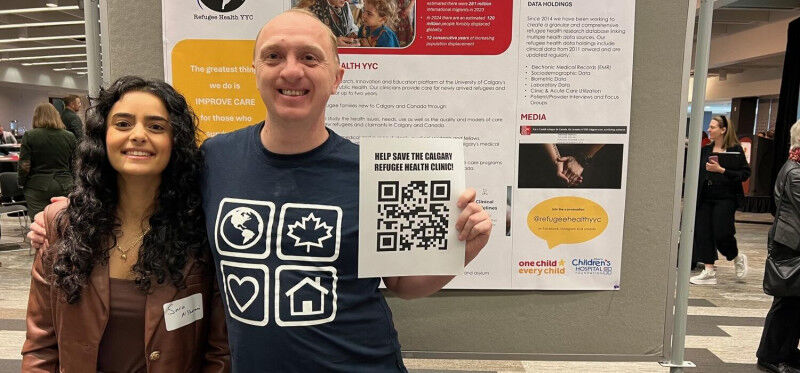
The Migrant and Humanitarian Health Collective (MHHC), a research platform of the Cumming School of Medicine ’s O’Brien Institute, has spent more than 10 years systematically collecting and linking health data from refugees and asylum claimants receiving care in Calgary. This work helps researchers better understand health needs, patterns of care and outcomes over time, and informs refugee health research and policy nationally.
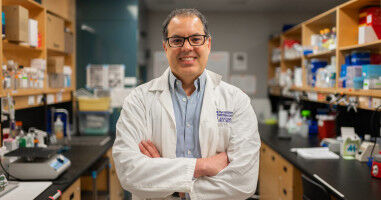
"When we started this work, there was no high-quality way to study refugee and asylum claimant health in Canada," says Dr. Gabriel Fabreau , co-director of MHHC, formerly Refugee Health YYC.
"These communities were largely invisible in existing health data. Building this dataset was essential because without it we simply could not study how to improve health or care for families forced to flee their homes," says Fabreau, BSc’04, MD’08, PGME’11, PGME’12.
A national research resource
The dataset did not emerge overnight. In its earliest days, the work relied on manual chart reviews entered into basic spreadsheets by a small research team."We began with nothing," Fabreau says.
"Over 12 years, we slowly improved, automated, cleaned, linked and verified the data. As Calgary became Canada’s western hub for refugee resettlement, and as the Calgary Refugee Health Clinic cared for more families, the dataset grew alongside them."
Calgary’s refugee-health landscape played a key role in enabling the work. The city is home to a high-functioning refugee-health clinic, one of Canada’s largest and longest continuously active, that has historically cared for most newly arrived refugees and asylum claimants in the region.
"That made Calgary a rare and ideal place to carefully track health needs and outcomes for families from all’over the world," Fabreau says.
"Few jurisdictions have that level of continuity."
Today, the research includes health information from more than 14,000 patients representing more than 110 countries, and more than 100,000 clinical encounters. The data is securely linked to Alberta’s health system, allowing researchers to examine patterns of care, outcomes and system-level impacts over time.
"It’s become one of the largest and most detailed refugee health research databases in North America," says Fabreau.
"It allows us to study issues, patterns, needs and gaps in care that were previously impossible to identify."
The dataset is also the product of long-term collaboration and mentorship. Fabreau credits the training he received at UCalgary, particularly through the APPROACH (Alberta Provincial Project for Outcome Assessment in Coronary Heart Disease) program and mentors including Drs. William Ghali, MD’90; Hude Quan, PhD’98; and Merril Knudtson, MD’75, for shaping his approach.
He also says the perspectives and contributions of team members with lived experience of forced migration have been key in informing what data is collected and how it is interpreted.
"This work reflects the value of building high-quality health research data to improve care for the people we serve," he says.
Understanding system strain beyond individual patients
The impact of the dataset is already being felt. A new publication, in The Lancet Regional Health - Americas , led by Eric Norrie, BA’18, MSc’23, a master’s student supervised by Fabreau in the Department of Community Health Sciences , is the first study to use the complete longitudinal set of MHHC data.The study examines how the Calgary Refugee Health Clinic adapted through four major system shocks over a 10-year period, including large-scale refugee resettlement, policy changes, and the COVID-19 pandemic. The research introduces the concept of operational burden, meaning the often-hidden costs incurred when health systems adapt to crises.
"Resilient health systems can’t be understood only by whether they respond to shocks," says Norrie.
"We also need to understand the operational burdens that come with that response including financial strain, material shortages, provider well-being, quality of care and infrastructure limitations."
The clinic was able to adapt and continue providing care, but this resilience came at a cost, including strain on staff well-being, pressure on clinic resources and infrastructure, and challenges in maintaining quality of care.
Importantly, the study emphasizes that system strain is driven by policy decisions, structural factors and external shocks, not by patients themselves.
"Patients and migrants are not to blame for using the systems we create for them," Norrie says.
"Policy decisions, epidemics and global crises create system shocks. Better data allows us to design better systems and policies that anticipate those realities."
A beacon clinic shaped by long-standing partnerships and trust
Partnership and trust were key to navigating each challenge at the Calgary Refugee Health Clinic. Dr. Annalee Coakley, MD, co-director of MHHC and a physician at the clinic, says adaptability was built over years of collaboration with community partners and refugee communities themselves."Our clinic team demonstrated significant flexibility in how and where we delivered care," Coakley says. This included on-site clinics in refugee hotels, partnerships with resettlement agencies and pharmacies, and community-led responses to mental health needs among highly traumatized populations.
During the COVID-19 pandemic, that experience proved invaluable.
"Because of the trust built over years, people came," says Coakley.
"That trust allowed us to respond quickly, safely and effectively during a time of extraordinary uncertainty."
The study describes the Calgary Refugee Health Clinic as a beacon clinic and hub of expertise that other parts of the health system can look to, particularly during periods of disruption.
Looking ahead
For the MHHC, the work highlights the power of sustained investment in research infrastructure. The dataset is currently being updated to include patient data through the end of 2025, which will strengthen its value as a national and international research resource.This work is also informing emerging collaborations with the World Health Organization ’s Programme of Migration Health and Lancet Migration.
"This study reflects years of persistence and teamwork," Fabreau says.
"It shows the power of patiently building research infrastructure that can truly change how health systems care for vulnerable populations."