UCalgary researchers are part of a Canadian-led Cycle 1 observing program
An international team of astronomers -- including researchers from the University of Calgary-- has uncovered two strikingly unusual "monster" black holes, revealing dramatic new clues about how galaxies are built and torn apart.
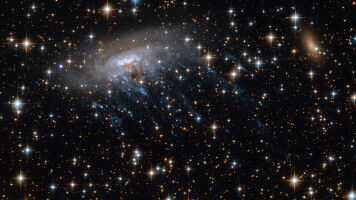
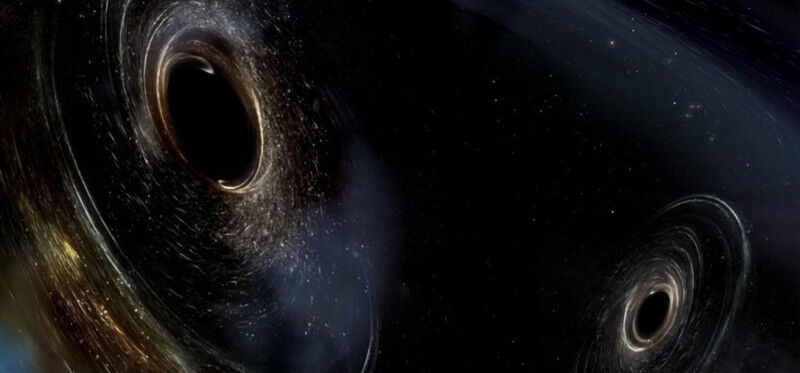
In two studies, the team examined the compact galaxy NGC 4486B in the Virgo Cluster and found that it hosts an extraordinarily massive black hole weighing roughly 360 million times the mass of the sun. Even more puzzling, the black hole is slightly offset from the galaxy’s centre - unusual, since they are typically anchored in the middle of their host galaxies.
The Virgo Cluster, about 55 million light-years from Earth, is a rich laboratory for studying galaxy evolution. With thousands of member galaxies, many actively interacting or recently disturbed, it offers a front-row seat to processes that shape galaxies over cosmic time.
The findings are published in The Astrophysical Journal Letters across three separate papers and based on observations from a Canadian-led Cycle 1 observing program using the James Webb Space Telescope ’s (JWST) NIRSpec instrument.
A black hole kicked off centre
"The discovery of this off-centre, post-merger supermassive black hole... offers a rare opportunity to study how black hole mergers play into their growth over cosmological timescales," says Dr. Matthew Taylor , PhD, assistant professor with the Department of Physics and Astronomy and lead author of one of the papers. "Catching this one so soon after the act is also a unique opportunity to see how the mergers sculpt the innermost regions of their host galaxies."
Astronomers have long known that nearly every large galaxy hides a supermassive black hole at its centre - cosmic heavyweights millions to billions of times more massive than our sun. Even more remarkably, these black holes appear to grow in step with their host galaxies, with tight relationships between their masses, suggesting they are key drivers of galaxy evolution.
Based on the ages and internal motions of NGC 4486B, the team estimates that, while the galaxies themselves may have merged billions of years ago, their two black holes likely took much longer to fully coalesce, possibly completing their final merger only within the last 30 or so million years.
Huge monster, tiny galaxy
In another study, the team turned to one of the smallest known types of galaxies: an ultra-compact dwarf called UCD736. These are dense stellar systems that blur the line between massive star clusters and stripped-down galaxies.
Using the telescope’s spatial resolution, the researchers detected a black hole weighing about two million times the mass of the sun at the centre of UCD736. For such a small galaxy, this is astonishing. The black hole accounts for roughly eight per cent of the galaxy’s total mass from all’its stars combined, far higher than the fraction of a percent seen in normal galaxies like the Milky Way.
This suggests that UCD736 was once a much larger galaxy whose outer layers were stripped away by the Virgo Cluster’s harsh dynamical environment, leaving behind its dense nucleus and central black hole. It also represents the detection of a supermassive black hole in the most compact stellar system identified to date.
"The NIRSpec instrument on JWST has given us the unique opportunity to search for supermassive black holes within smaller and fainter galaxies than was possible with ground-based telescopes," says Solveig Thompson, BSc’22, MSc’24, a UCalgary PhD candidate in physics and astronomy who’s also a member of the discovery team.
Together, the two galaxies demonstrate how studying the "monster" at a galaxy’s heart can act as a cosmic time capsule, preserving clues about the violent processes that shape galaxies.
The team plans to continue investigating similar systems in the Virgo Cluster and beyond to better test models of galaxy evolution and to uncover more monsters hiding in unexpected places.
The project received financial support from the Canadian Space Agency.